
Govt weighs new ATMs in big help for small change
The Centre is exploring ways to make small denomination notes available, aiming to resolve a shortage after demonetization. Proposed are currency-dispensing machines for ₹10, ₹20 and ₹50 notes, hybrid ATMs for exchanging notes and coins, and increased printing of small denomination currency notes.The government is considering deploying new ATMs to address the shortage of small denomination notes. The RBI employees flagged this issue. The All India Reserve Bank Employees Association urged the RBI to ensure an adequate supply of small denomination notes.
Govt weighs new ATMs in big help for small change ATMs to dispense cash, change; RBI may issue more smaller denomination notes Subhash Narayan & Gireesh Chandra Prasad NEW DELHI The Centre is exploring multiple ways to make small-denomination currency notes more widely available, in a move to address a persistent shortage that has plagued everyday cash transactions nearly a decade after demonetization.
The proposal includes a new kind of currency-dispensing machine to issue 10, 20 and 50 notes on demand, a 'hybrid ATM' that can exchange large notes for smaller denominations and coins, and a move to push the central bank to print more small denomination currency notes, according to two officials familiar with discussions within the government.
"A prototype of low-denomination currency dispensing machines is currently being tested under a pilot project in Mumbai," the first official cited above said on condition of anonymity. "Once approved, the system is expected to be scaled up nationally." These machines will be installed at high-footfall public locations such as transport hubs, markets, hospitals and government offices.
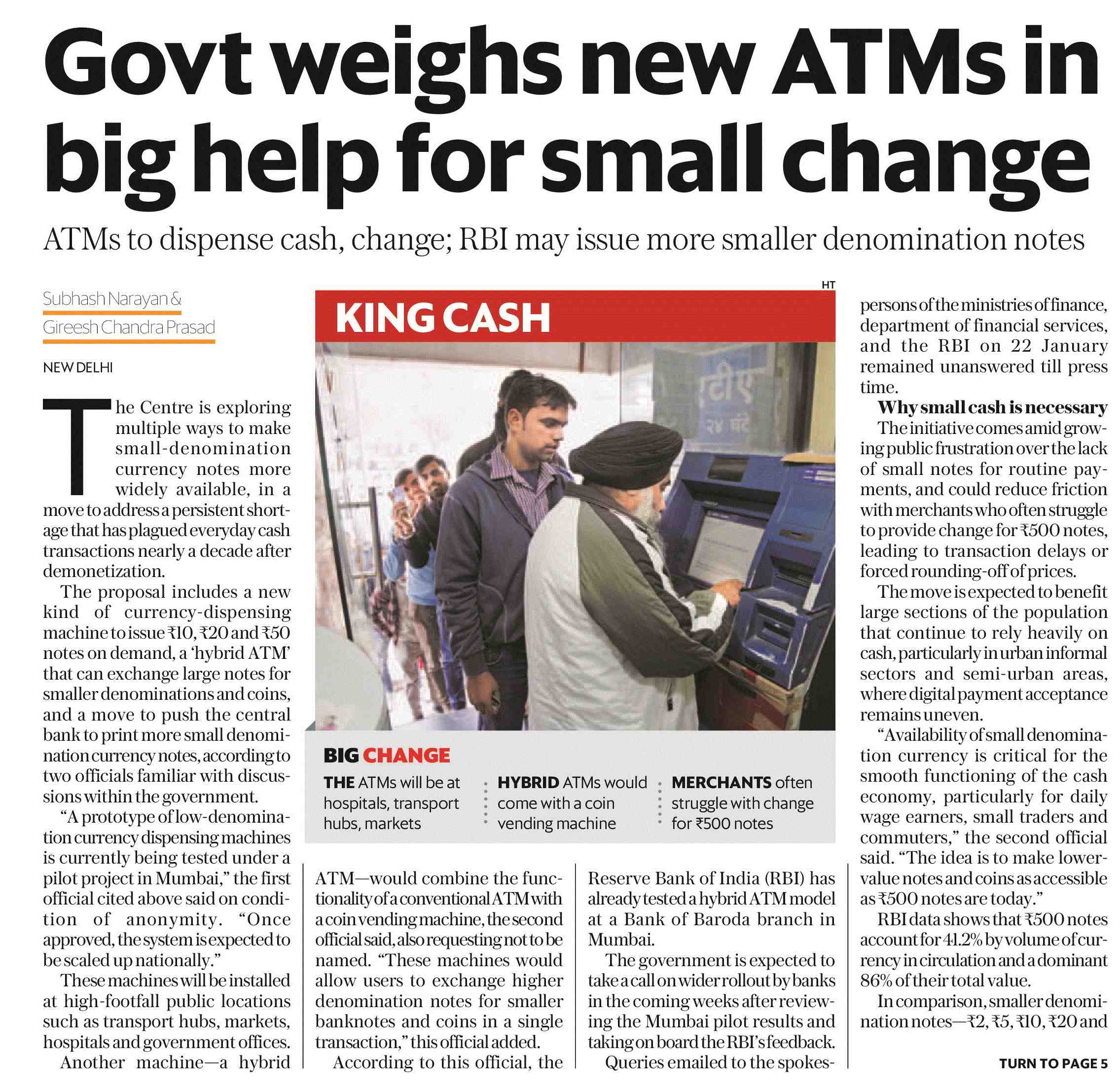
Another machine-a hybrid KING CASH BIG CHANGE THE ATMs will be at hospitals, transport hubs, markets HYBRID ATMs would come with a coin vending machine MERCHANTS often struggle with change for ₹500 notes HT ATM-would combine the functionality of a conventional ATM with a coin vending machine, the second official said, also requesting not to be named. "These machines would allow users to exchange higher denomination notes for smaller banknotes and coins in a single transaction," this official added.
According to this official, the Reserve Bank of India (RBI) has already tested a hybrid ATM model at a Bank of Baroda branch in Mumbai.
The government is expected to take a call on wider rollout bybanks in the coming weeks after reviewing the Mumbai pilot results and taking on board the RBI's feedback.
Queries emailed to the spokes-persons of the ministries of finance, department of financial services, and the RBI on 22 January remained unanswered till press time.
Why small cash is necessary The initiative comes amid growing public frustration over the lack of small notes for routine payments, and could reduce friction with merchants who often struggle to provide change for ₹500 notes, leading to transaction delays or forced rounding-off of prices.
The move is expected to benefit large sections of the population that continue to rely heavily on cash, particularly in urban informal sectors and semi-urban areas, where digital payment acceptance remains uneven.
"Availability of small denomination currency is critical for the smooth functioning of the cash economy, particularly for daily wage earners, small traders and commuters," the second official said. "The idea is to make lowervalue notes and coins as accessible as 500 notes are today." RBI data shows that 500 notes account for 41.2% by volume of currency in circulation and a dominant 86% of their total value.
In comparison, smaller denomination notes-₹2, 5, 10, 20 and TURN TO PAGE 5Govt weighs new ATMs in big help for small change FROM PAGE 1 ₹50-together comprise about 38% of total currency by volume, but only about 3.1% by value. The balance is accounted for by ₹100 and ₹200 notes. Devendra Pant, chief economist, India Ratings and Research, said having more small notes in circulation will help facilitate daily transactions, especially in rural areas where feature phones-which have low support for digital transactions-are still widely used. "Also, in rural settings, especially in interior parts, traders will have small volume and value of transactions per day. It is the government's responsibility and priority to improve ease of living," Pant said. Early warning The issue of an acute shortage of small denomination notes across large parts of the country, particularly in semi-urban and rural areas, was earlier flagged by RBI employees' unions. In December 2025, the All India Reserve Bank Employees Association (Airbea) urged the RBI in a letter to ensure adequate supply of small denomination notes, warning that while higher value notes such as ₹100, ₹200 and ₹500 were easily available, lower denominations were "almost unavailable" causing "enormous problems in public life". "ATMs dispense higher denomination notes only, and there is no provision for availability of small denomination notes," Airbea general secretary Samir Ghosh wrote to RBI deputy governor T Rabi Shankar. Expert views Some say machines alone don't offer a solution. "The machines alone cannot solve the problem unless backed by adequate supply. Printing, logistics and recirculation of smaller notes will have to be scaled up in parallel," said a banking sector executive on condition of anonymity. Industry experts also caution that the rollout must be carefully calibrated. "Addressing the challenge of limited small denomination currency is the right approach to take as a regulator-the question is not whether the initiative is right, but at what scale it should be implemented," said Vivek Iyer, partner and financial services risk leader at Grant Thornton Bharat. "With the government's strong digitisation agenda, this initiative should ideally be deployed at select locations only, as a large-scale rollout could prove uneconomical for banks. The right approach would be to apply these models where digital infrastructure is still evolving, so that currency availability is balanced with the maturity of digital payments," Iyer said. More money in the system To be sure, the value of money in circulation has more than doubled since the days of demonetisation. As on 4 November 2016, just days before demonetisation, currency in circulation stood at ₹17.97 trillion, according to RBI data, compared to ₹39.27 trillion as on 9 January 2026. Of this ₹17.97 trillion, ₹500 and ₹1,000 notes accounted for ₹15.41 trillion or 86% of their total value and about 25% by volume. Smaller denominations of ₹100,50,20 and 10 banknotes accounted for over 74% of the volume then. subhash.narayan@live-mint.com