
Achieving UPI's '1-billion' dream
India aims for a $10 trillion digital economy by 2026, relying on UPI infrastructure by PhonePe, Google Pay, and Paytm. UPI recorded ₹28,334 billion in transactions in January 2026. The goal is to reach one billion users, requiring rural penetration. Banks are facing higher technical decline rates in UPI than private platforms.
Achieving UPI's '1-billion' dream CASH-LESS. To acquire another 600 million users, a concerted push in rural and semi-rural regions will be needed GANGA NARAYAN RATH CHIRAYU SHARMA he active users of UPI are about 400 million. We are targeting one billion users.
So.....there is a lot of scope, there is a lot of distance that we need to travel," said T Rabi Sankar, Deputy Governor of RBI, while speaking at Global Inclusive Finance India Summit, recently.
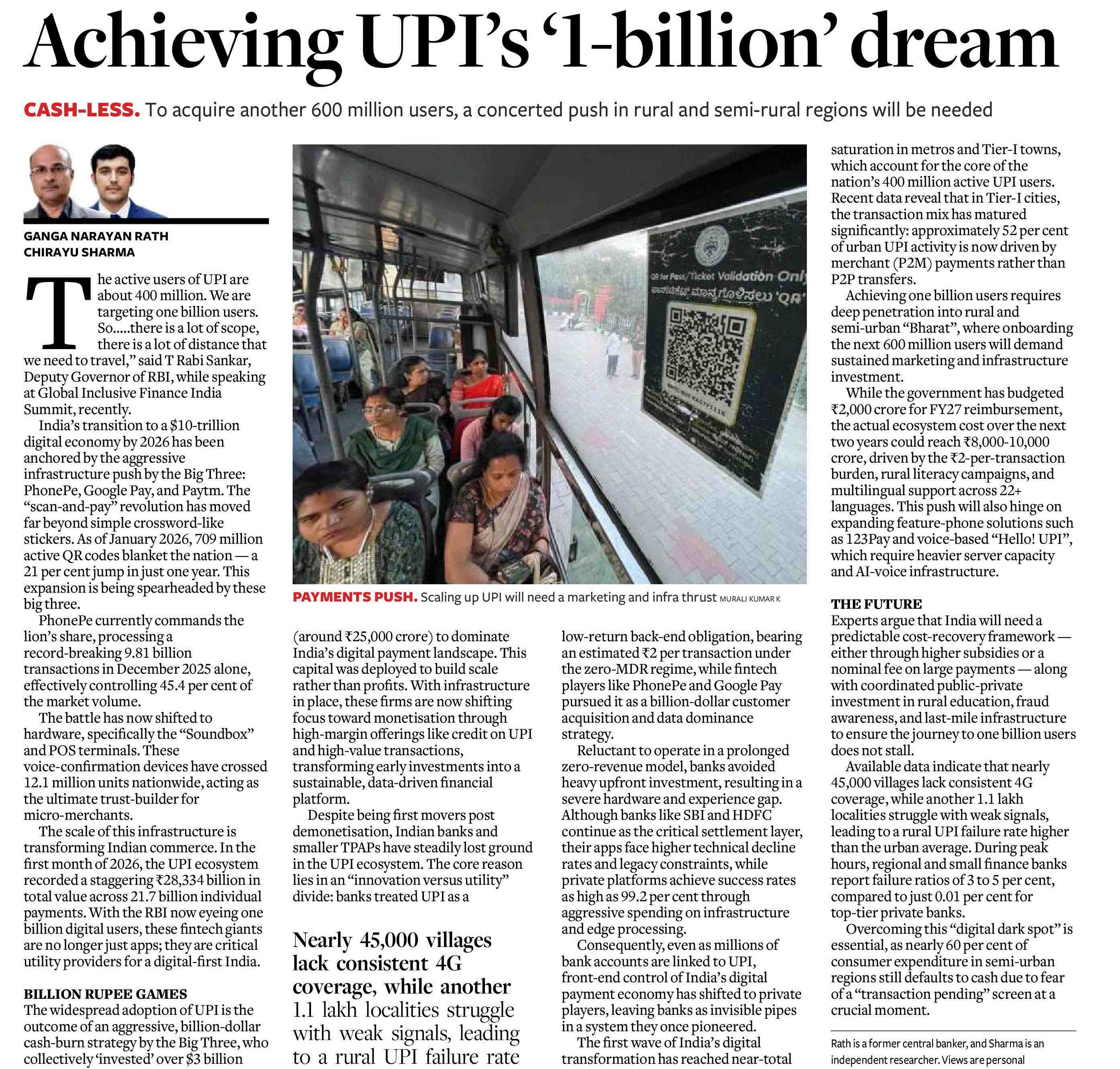
India's transition to a $10-trillion digital economy by 2026 has been anchored by the aggressive infrastructure push by the Big Three: PhonePe, Google Pay, and Paytm. The "scan-and-pay" revolution has moved far beyond simple crossword-like stickers. As of January 2026, 709 million active QR codes blanket the nation - a 21 per cent jump in just one year. This expansion is being spearheaded by these big three.
PhonePe currently commands the lion's share, processing a record-breaking 9.81 billion transactions in December 2025 alone, effectively controlling 45.4 per cent of the market volume.
The battle has now shifted to hardware, specifically the "Soundbox" and POS terminals. These voice-confirmation devices have crossed 12.1 million units nationwide, acting as the ultimate trust-builder for micro-merchants.
The scale of this infrastructure is transforming Indian commerce. In the first month of 2026, the UPI ecosystem recorded a staggering ₹28,334 billion in total value across 21.7 billion individual payments. With the RBI now eyeing one billion digital users, these fintech giants are no longer just apps; they are critical utility providers for a digital-first India.
BILLION RUPEE GAMES The widespread adoption of UPI is the outcome of an aggressive, billion-dollar cash-burn strategy by the Big Three, who collectively 'invested' over $3 billion (around ₹25,000 crore) to dominate India's digital payment landscape. This capital was deployed to build scale rather than profits. With infrastructure in place, these firms are now shifting focus toward monetisation through high-margin offerings like credit on UPI and high-value transactions, transforming early investments into a sustainable, data-driven financial platform.
Despite being first movers post demonetisation, Indian banks and smaller TPAPs have steadily lost ground in the UPI ecosystem. The core reason lies in an "innovation versus utility" divide: banks treated UPI as a Nearly 45,000 villages lack consistent 4G coverage, while another 1.1 lakh localities struggle with weak signals, leading to a rural UPI failure rate low-return back-end obligation, bearing an estimated ₹2 per transaction under the zero-MDR regime, while fintech players like PhonePe and Google Pay pursued it as a billion-dollar customer acquisition and data dominance strategy.
Reluctant to operate in a prolonged zero-revenue model, banks avoided heavy upfront investment, resulting in a severe hardware and experience gap.
Although banks like SBI and HDFC continue as the critical settlement layer, their apps face higher technical decline rates and legacy constraints, while private platforms achieve success rates as high as 99.2 per cent through aggressive spending on infrastructure and edge processing.
Consequently, even as millions of bank accounts are linked to UPI, front-end control of India's digital payment economy has shifted to private players, leaving banks as invisible pipes in a system they once pioneered.
The first wave of India's digital transformation has reached near-total saturation in metros and Tier-I towns, which account for the core of the nation's 400 million active UPI users.
Recent data reveal that in Tier-I cities, the transaction mix has matured significantly: approximately 52 per cent of urban UPI activity is now driven by merchant (P2M) payments rather than P2P transfers.
Achieving one billion users requires deep penetration into rural and semi-urban "Bharat", where onboarding the next 600 million users will demand sustained marketing and infrastructure investment.
While the government has budgeted
₹2,000 crore for FY27 reimbursement, the actual ecosystem cost over the next two years could reach ₹8,000-10,000 crore, driven by the ₹2-per-transaction burden, rural literacy campaigns, and multilingual support across 22+ languages. This push will also hinge on expanding feature-phone solutions such as 123Pay and voice-based "Hello! UPI", which require heavier server capacity and AI-voice infrastructure.
THE FUTURE Experts argue that India will need a predictable cost-recovery framework either through higher subsidies or a nominal fee on large payments - along with coordinated public-private investment in rural education, fraud awareness, and last-mile infrastructure to ensure the journey to one billion users does not stall.
Available data indicate that nearly 45,000 villages lack consistent 4G coverage, while another 1.1 lakh localities struggle with weak signals, leading to a rural UPI failure rate higher than the urban average. During peak hours, regional and small finance banks report failure ratios of 3 to 5 per cent, compared to just 0.01 per cent for top-tier private banks.
Overcoming this "digital dark spot" is essential, as nearly 60 per cent of consumer expenditure in semi-urban regions still defaults to cash due to fear of a "transaction pending" screen at a crucial moment.
Rath is a former central banker, and Sharma is an independent researcher. Views are personal